TR19 certificate automation: how to issue compliance certificates the same day.
Every TR19 kitchen extract clean ends with a certificate, and for many contractors that certificate is the slowest part of the job. Photos go to an outsourced provider, the paperwork comes back days later, and a monthly fee is paid for the privilege. This is how one UK contractor replaced that with a certificate generated in seconds, and what it takes to do the same.
Why the certificate is the bottleneck
The cleaning itself is not where the delay lives. The engineer finishes the work, takes photos, and leaves. The client, meanwhile, needs proof that the extract system has been cleaned to the standard, for their own fire risk assessment and their insurer. Until that document arrives, the job is not really finished from their point of view, and in many businesses it is not really finished from an invoicing point of view either.
The certificate is a small document with a simple job to do. The trouble is the route it takes to get made. It depends on someone, somewhere, turning photos and job notes into a formatted record, and that person is rarely the engineer who was on site.
The outsourced route, and what it costs
A common set-up is to pass the paperwork to an outside company. The engineer sends photos of the completed job, and the provider assembles the certificate and returns it. That works, but it has three costs that are easy to underestimate.
- Time. Certificates come back in days rather than hours, so the client waits and invoicing waits with them.
- Money. The service is usually a recurring fee. For CITYi Limited, a UK kitchen extraction cleaner, it was £300+ a month.
- Control. Your compliance records depend on someone else's turnaround and someone else's format, and you cannot see where a certificate is until it arrives.
That is one business, and the figure is theirs, not an industry average. But the shape of the problem will be familiar to any contractor who has ever chased a certificate.
What we built instead
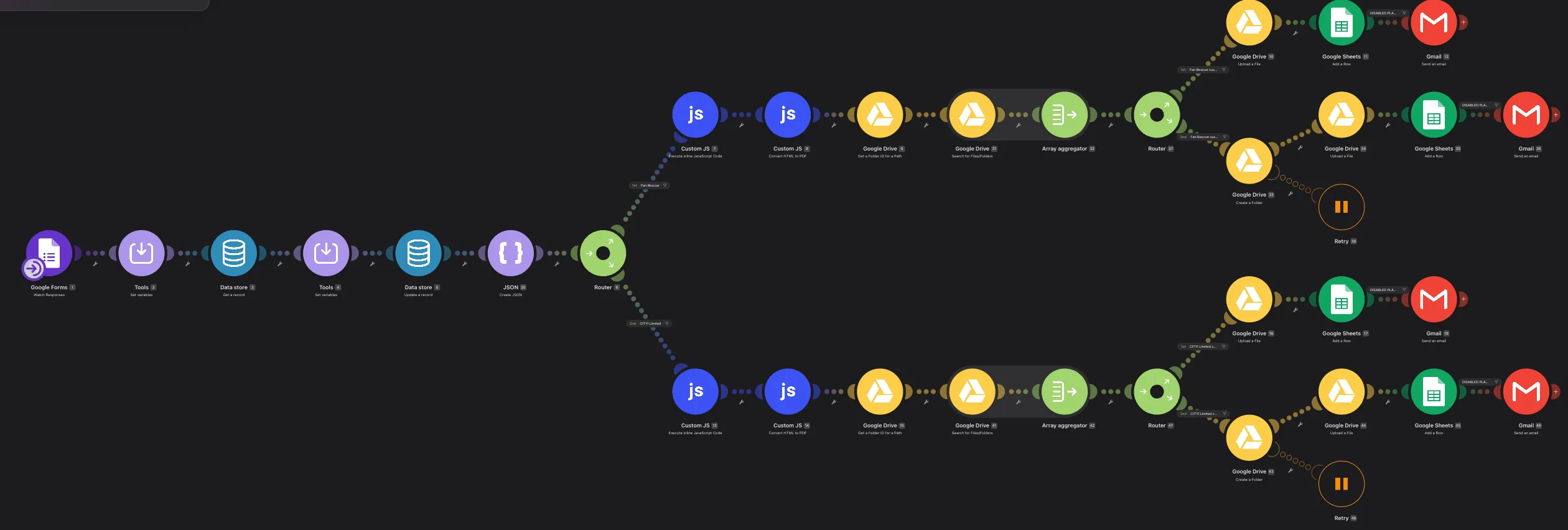
The replacement is deliberately simple. It does not try to change how the cleaning is done, only how the paperwork is produced. The flow has five steps:
- The engineer completes a Google Form on their phone the moment the job is finished. Job details, site information and compliance parameters are captured at source.
- The submission triggers a Make.com scenario instantly. Nobody in the office has to pick it up.
- A branded PDF certificate is generated, populated with that job's data.
- The finished certificate is filed in Google Drive, so the business holds its own permanent record of every job.
- The certificate is emailed back to the engineer, who checks it and forwards it to the client.
The certificate exists before the engineer has left site, and the only human step left is the review, which is the step you want a person to keep. The scenario also routes by client, so certificates land in the right Drive folder without anyone sorting them.
What it costs to run
The running cost is Make.com credits and nothing else: no per-certificate fee, and no monthly charge to a third party. The forms, storage and email run on Google tools the business already uses. Compare that with a recurring outsourcing fee and the difference is a line on the monthly cost sheet that simply disappears, while the certificate arrives in seconds instead of days.
There is a one-off build cost, of course, and a small amount of time to set the template up properly. If you want to see how the numbers compare, add up what you currently pay for certificates over a year, and set it against a fixed build and a few Make.com credits a month. Your own figures will be different from CITYi's, but the comparison is easy to run.
Rolling it out without disruption
The safest way to introduce this is alongside the existing process, not instead of it. For the first batch of jobs, the engineer completes the form and the certificate is generated as normal, but the old route still runs in parallel. Compare the two outputs. If the automated certificate matches, or improves on, what the outsourced provider produced, you have your evidence that it is safe to switch.
That parallel period also shakes out the practical problems: a form field engineers misread, a site name typed three different ways, a template line that does not fit a particular type of job. Fixing those on ten jobs is far cheaper than fixing them on a hundred. Once the outputs are consistently right, the outsourced service can be stopped, and the monthly fee stops with it.
The engineers are the people who make or break it. The form has to be quicker than the alternative, which is the point of building it for a phone. If it takes longer than sending photos, it will not be used. If it takes two minutes and the certificate appears in their inbox before they have driven away, it will be.
Where it can go wrong
- A poor form. The certificate can only be as accurate as the data captured on site. Keep the form short, make the compliance fields required, and test it on a real phone in a real kitchen.
- An unreviewed template. The certificate wording is your responsibility. Have whoever holds your accreditation approve the template before anything goes to a client, and check it against current BESA guidance.
- Removing the human check. The engineer's review is what catches a wrong site name or a missing reading. Automate the production, keep the sign-off.
- Messy folder structure. Decide how Drive folders are organised by client and site before you build, or the archive becomes hard to search.
- Treating it as a compliance fix. Automation speeds up and standardises the paperwork. It does not make a job compliant. The cleaning still has to meet the standard.
Beyond the certificate
Once completion data is captured in a form, it is reusable. The same information can feed automated client reporting, so each contract gets a consistent report without someone compiling it by hand. The certificate history also tells you when each site is next due, which is the raw material for the renewal process we describe in our guide to service agreement renewal automation. And the quote that started the job can be generated the same way, as covered in proposal automation for field service businesses.
We have run this pattern end to end for another UK kitchen extraction business too, including invoicing and proposals from a single WhatsApp chat. The walkthrough and the 90-day results show what that looks like in practice.
Who this suits
It suits contractors who issue certificates or completion records on every job, and who are either outsourcing that step or losing time to it. If that is you, see our page for cleaning and facilities businesses, the wider field services work, and our document automation service, which is the general version of what is described here.
A quick test: if you can name the person who chases certificates each week, or you can point to the monthly invoice for producing them, there is almost certainly a build worth doing. If certificates already go out within the hour and cost you nothing extra, there probably is not, and we will say so on the call.
Paying someone else to produce your certificates?
Book a 20-minute discovery call. We'll look at how your certificates are produced today and tell you plainly whether it is worth automating.